
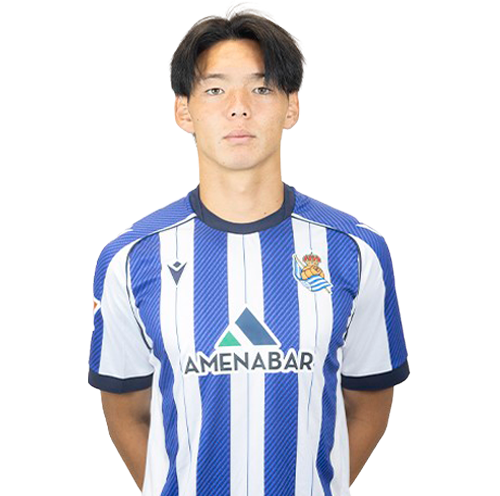
- Date of Birth: 16/09/2005
- Age: 20
- Nationality: 🇯🇵 Japan
- Preferred Position: CB
- Alternative Positions: –
- Club: Real Sociedad B
- Height: 189 cm
- Contract Until: 30/06/2027
Day 20… and with the same energy as the first one 😉
Feels great to see how my reports developed in this short period of time, and in my view are now more precise, objective and detailed.
Now, enough with the emotional part… Today we have yet again another Japanese gem talent after Akito Suzuki and Ryunosuke Sato. Non other than Real Sociedad B’s defender Kazunari Kita.
Kazunari Kita is a center back currently playing in Spain’s second division, La Liga Hypermotion, on loan from Kyoto Sanga.
He has performed there and has even been called for first team matches, despite not getting any minutes.
Can he make it to the first team? Will he stay in Europe and make a career here? Let’s find out!
Great defense and an amazing build up… not yet seen due to context?
Let’s start with some context first.
In Spanish football, unlike in England, reserve teams (B teams) compete within the official league pyramid. The only major structural limitation is that they cannot share a division with their first team. If the senior side is in La Liga, the B team cannot be promoted there. If the first team gets relegated to the same division as the B team, the reserve side is automatically relegated.
There are additional restrictions as well. B teams operate under registration and eligibility rules, including limits on overage players and certain administrative constraints regarding squad composition. The objective is development, not direct competition with the senior project.
This differs significantly from England. In English football, academy sides compete in separate competitions such as Premier League 2, and while some youth teams participate in cups like the EFL Trophy, they do not climb the main league pyramid. Spain’s model, by contrast, exposes young players to fully professional, high-stakes football much earlier.
In recent years, clubs like Villarreal CF and Real Sociedad have seen their B teams promoted to Spain’s second division, La Liga Hypermotion, only to be relegated one or two seasons later. This recurring cycle — promotion followed by relegation — is informally referred to as a “lift” effect. The teams go up… and then down again.
Because of this structural dynamic, B teams are often among the favorites to go down. They tend to be younger, less experienced, more error-prone and, at times, less consistent. Survival, not dominance, is usually the objective.
Within that demanding environment, Real Sociedad B achieved promotion last season and are now fighting to retain their status in La Liga Hypermotion. One of the key additions brought in to help stabilize the squad was Kazunari Kita.
Kazunari Kita, the Japanese defender developed at Kyoto Sanga, had only featured twice for the senior team across the previous two seasons. When Real Sociedad signed him in the summer, many in Spain initially framed the move as a marketing strategy — another Japanese player to expand the brand and sell shirts.
Kazunari Kita has quickly proven that narrative wrong.
Defensively, he has been extremely reliable. Despite his lean frame, Kazunari Kita consistently wins duels — particularly aerial ones, where his height gives him a clear advantage. His timing in tackles is sharp, and he excels at clearing danger inside the box, preventing second balls and chaotic rebounds. For a team battling relegation, those small defensive details are invaluable.
In short, Kazunari Kita has shown at Real Sociedad B that he can do exactly what is required of him: defend with efficiency and composure.
But there is more to his profile than what he has displayed so far in Spain.
Kazunari Kita possesses strong build-up qualities from the back. His short distribution is clean, his long passing can break lines, and his ball-carrying ability allows him to step into midfield and progress play under pressure. These traits were more visible during his appearances with Japan’s U20 national team and in his limited cameos at Kyoto Sanga.
If Kazunari Kita manages to fully translate that technical and progressive dimension of his game to European football, we may be looking at a Japanese defensive prospect of a level rarely seen — and that comparison must be made carefully, out of respect for someone like Maya Yoshida.
Not translating his game properly… but why?
Now, all of this might make it sound like his development is simply a matter of time — that once confidence and continuity fully align, Kazunari Kita will naturally unlock the complete version of himself that we saw with Japan U20 and in glimpses at Kyoto Sanga.
And maybe that’s true.
But what if it isn’t?
In my view, he will get there. The technical foundation is real. The flashes weren’t accidental. Still, development is never guaranteed. If that progressive side of his game does not fully translate to European football, what remains is a tall, physically imposing, defensively reliable centre-back — but one who might lack the ball progression, link-up sharpness and distribution impact required at higher levels.
Up to this point, Kazunari Kita has tended to favor the safe option in possession. Conservative passes, low-risk decisions, minimal vertical exposure. That approach makes sense in a relegation battle context, especially for a young defender adapting to a new country and system. Stability often comes before expression.
However, on the occasions when he has attempted more ambitious passes, there have been a few mistimed executions — moments that led to dangerous transitions or visible nervousness, both for him and his teammates. Nothing dramatic, but enough to suggest that he is still calibrating that side of his game in Spain.
Of course, not every centre-back needs to be an elite distributor. Defensive solidity alone can build a strong professional career.
But in Kazunari Kita’s case, the expectation is slightly different — because we know he has more. He has already shown that he can break lines, carry the ball forward and play progressive passes with confidence.
If he limits himself to purely defensive tasks, he will remain valuable. If he reclaims and refines that progressive dimension, he becomes something far more interesting.
Summary
Strengths:
- Positioning and timing
- Tackles
- Interceptions
- Duel winner
- Aerial best, both as a threat in corners and aerial duels
- Great build up from the back (?)
- Ball progression (?)
Weaknesses:
- Game not translating entirely
- Currently limited passing and some mistakes from the back
Player Comparison
In these images, the player is ranked against others in the same position and league. For each metric, you’ll see the statistic name, the player’s average per 90 minutes, and their percentile rank—which shows how they compare to their peers (e.g., an 80th percentile means they performed better than 80% of players in that group).
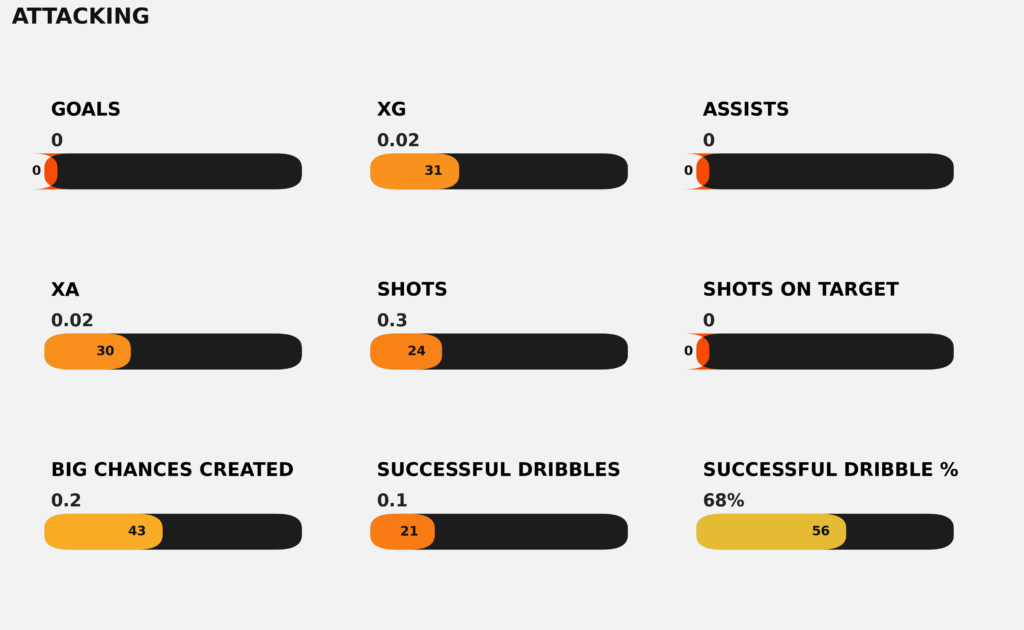
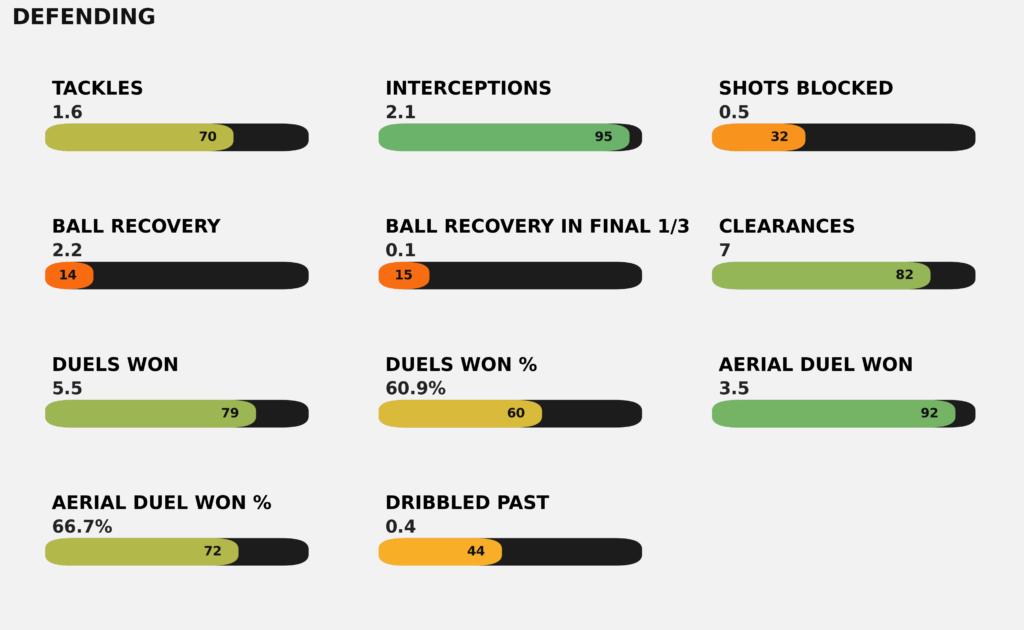
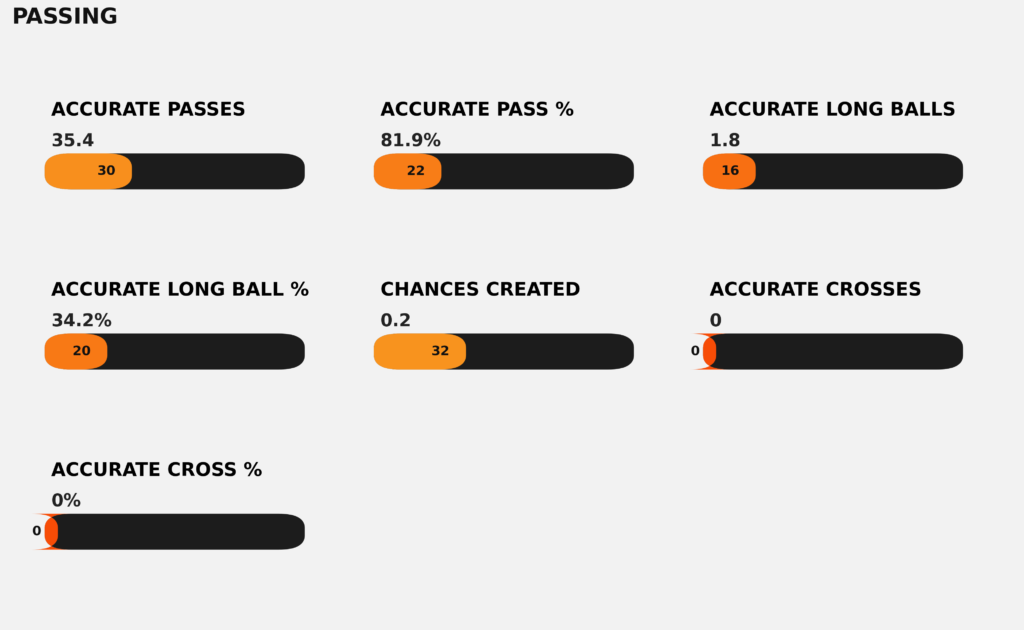
Future Moves and Player Expectations
Kazunari Kita’s future seems linked to what plans does Real Sociedad have for him. If they plan to keep him and loan him at another La Liga or La Liga Hypermotion club, that would be the best option for him to continue getting minutes and adapt fully to the league context.
If not, I would look for some team in a Top 6-8 league to develop in, preferably in Belgium or the Netherlands.
Lastly, as always, let’s use some other players to represent the hopes and aspirations we have on Kazunari Kita:
Best-Case Scenario
Marc Bartra — A tall and lean center back who is able to play from the back, has great passing and is strong defensively.
Expected Outcome
Maya Yoshida — Legendary Japanese player, might very well be one of the most renowned. He was great at aerial duels, strong defensively, composed and had a decent passing.
Worst-Case Scenario
Florian Lejeune — Even though Kazunari will never reach Lejeune’s shooting, he possesses his clearances, tackles, defensive actions, positioning and aerial threat.
Don’t miss out on our other player reports, look at them here.
And don’t forget to check our Instagram account, where you can find summarized player reports.