

- Date of Birth: 19/03/2005
- Age: 20
- Nationality: 🇪🇨 Ecuador
- Preferred Position: ST
- Alternative Positions: –
- Club: Stuttgart
- Height: 182 cm
- Contract Until: 30/06/2031
Welcome back to this amazing series. Today after a long wait, we will be reviewing one of the most promising talents coming up from La Liga Hypermotion in recent years: Jeremy Arévalo.
After a surprising break out start of the season, with 8 goals in 18 games, Arévalo was signed by Stuttgart, being the first player in this series to play in Germany. There, he has struggled as of now, and has barely played nor contributed in his appearances…
Will he turn around this situation or was this first half of the season a lucky succession of performances?
A traditional number 9: A threat in the box
Racing Santander are currently sitting at the top of the league, delivering consistent, high-level performances week after week and establishing themselves as one of the most dangerous attacking sides in the competition. Even in their Copa del Rey clash against FC Barcelona, Racing showed no fear, creating several clear chances that could have changed the outcome of the game if they had been more clinical.
Their attacking structure is built around some of the best facilitators in the league, with Íñigo de Vicente standing out above the rest. He leads almost every metric related to passing, chance creation, and tempo control, acting as the brain of Racing’s offense. This context matters when evaluating Arévalo because—being fully honest—this environment has played a big role in his success. That’s not to downplay his merit, but rather to properly frame why his profile works so well in this team.
Within this system, Arévalo had a very clear and defined role: to be a pure, traditional number 9. His job was to fix defenders, constantly attack the box, make runs behind the defensive line, finish crosses, and stay alert for rebounds and second balls. And he absolutely delivered. In just 874 minutes across 18 appearances, he scored 8 goals, including a brace that shocked league leaders Almería at the time—a statement performance that put him on the radar.
However, Arévalo is more than just a box finisher. He has enough pace to threaten space behind the defense and a decent technical level that allows him to carry the ball with close control, making it difficult for defenders to step in cleanly. He won’t beat five players in a row, but he doesn’t need to—he knows how to use his body and timing effectively.
Where he truly shines is in his movement and positioning inside the box. Arévalo shows great instincts and awareness, often manipulating defenders with small feints or subtle movements, dragging them one way before taking a couple of steps back to create separation. That extra half-second of space is usually enough for him to get a clean shot off, and it’s a trait you rarely see in young strikers.
This is perfectly illustrated in the image below.

Representation of how Arévalo tricks defenders to enable some space for himself.
Image done using Tacticalista app.
A diamond… that needs to be carefully treated and polished
Arévalo truly shined and was able to show the very best version of himself, exploiting almost every strength in his skill set. Racing Santander offered him an ideal environment: a dominant, attacking team, full of creativity and chance creation, where his role was clear, simple, and perfectly tailored to what he does best. He didn’t need to drop deep, organize play, or constantly be involved in buildup. His mission was straightforward: attack the box, finish actions, and punish defenses. And he did exactly that.
However, this same context also exposes one of the biggest uncertainties surrounding his profile. He thrived in a system that maximized his strengths while hiding his weaknesses. Racing’s midfield supplied him with constant service, reduced his responsibility outside the box, and allowed him to focus on timing, movement, and finishing. On top of that, the pressure was minimal. Being a player developed in Racing de Santander’s academy, he enjoyed trust from the club, patience from the fans, and an emotional connection that naturally protects young players when things don’t go perfectly.
That safety net no longer exists.
The move to Stuttgart represents a completely different reality. Here, Arévalo is no longer “one of ours” — he is a signing, and an investment. With that comes a price tag, expectations, and immediate scrutiny. He arrives in a league that is more physical, faster, tactically demanding, and unforgiving, where defenders are stronger, spaces are tighter, and mistakes are punished instantly. On top of that, he is unknown to the local fanbase, which means he has to earn trust from zero, through performances alone.
Naturally, the adaptation hasn’t been smooth. Jeremy is struggling in these early stages, and honestly, that was always the most likely scenario. He is now asked to do more outside the box: participate in buildup, link play, press with intensity, and sometimes survive with fewer touches and fewer clear chances. The margins are smaller, and the rhythm of the game doesn’t always allow him to rely purely on instinct and movement.
There’s also the mental side of the challenge. Confidence plays a massive role for strikers, and when goals don’t come quickly, doubts start to appear. Every missed chance feels heavier, every game without scoring louder. Combine that with a new country, new language, new teammates, and a different football culture, and the difficulty of the transition becomes clear.
None of this means Arévalo lacks quality — quite the opposite. It simply highlights that his development is entering a new, more complex phase. The question is no longer whether he can finish chances in a favorable system — he already answered that. The real test now is whether he can adapt, evolve, and expand his game enough to survive and eventually shine in a less forgiving context.
Summary
Strengths:
- Finishing
- Duel winner
- Dribbling and athleticism
- Speed
Weaknesses:
- Lack of game time in big leagues
- Relies on facilitators
- Confidence/Adaptation problems to other leagues (?)
Player Comparison and Future Expectations
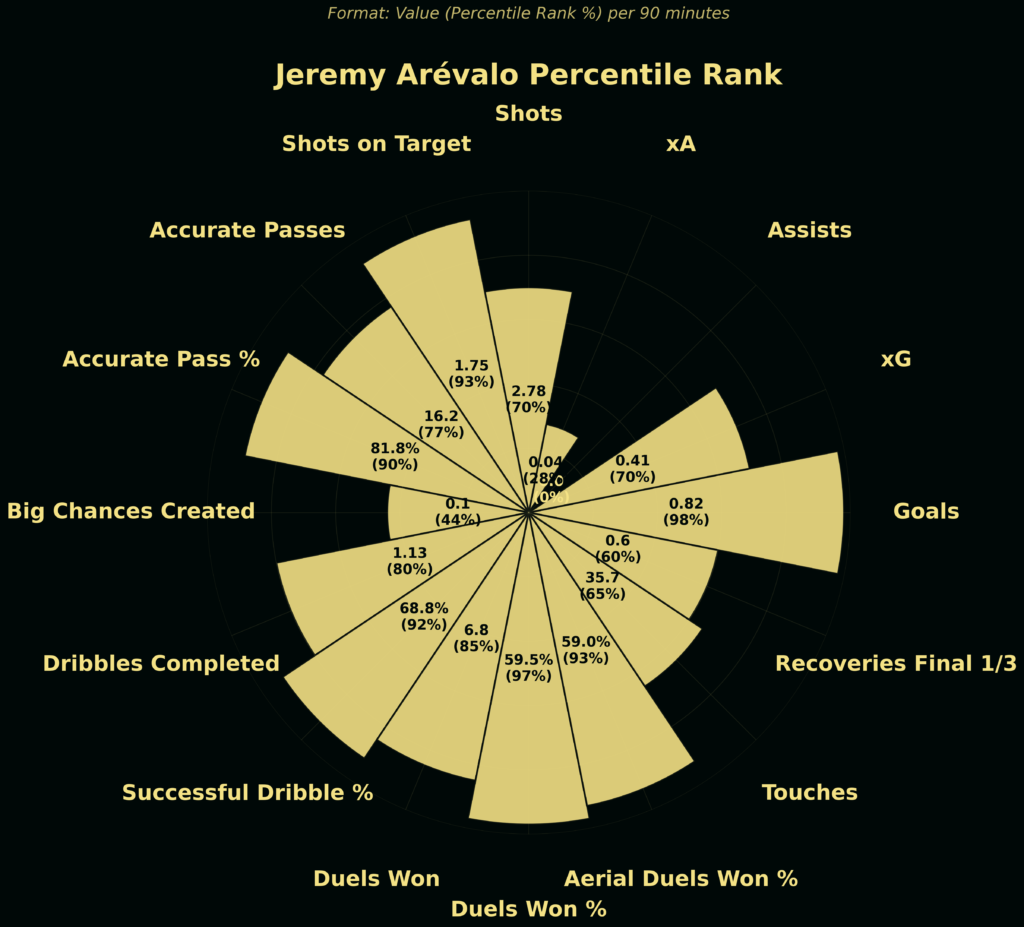
In the short term future for Arévalo, he will need to work hard and understand his new role to be able to shine and perform at Stuttgart as he did before in Racing de Santander.
If he is able to do so and starts performing, a move to an even bigger club seems plausible. I find him a great fit for the Premier League, thanks to his speed and finishing. I know I said this in Saidu’s report too, but Brighton will be a perfect fit, and this is the kind of player with a random nationality that they love to sign.
To contextualize his potential, here are some expected outcomes for him:
Best-Case Scenario
Ferran Torres — A sharp striker, an underrated player that can fix defenders, dribble, punish spaces behind their back and finish chances, somet more reliably than others.
Expected Outcome
Arnaut Danjuma (Villarreal years) — A fast striker that could materialize every chance he got. Sharp, with great athleticism and an amazing finish.
Worst-Case Scenario
Sheraldo Becker — Nice winger, who relies on his physical attributes a lot and struggles without open spaces, but who can still perform without being involved in G/A due to the threat he represents.
See all our Scouted Players clicking here.