
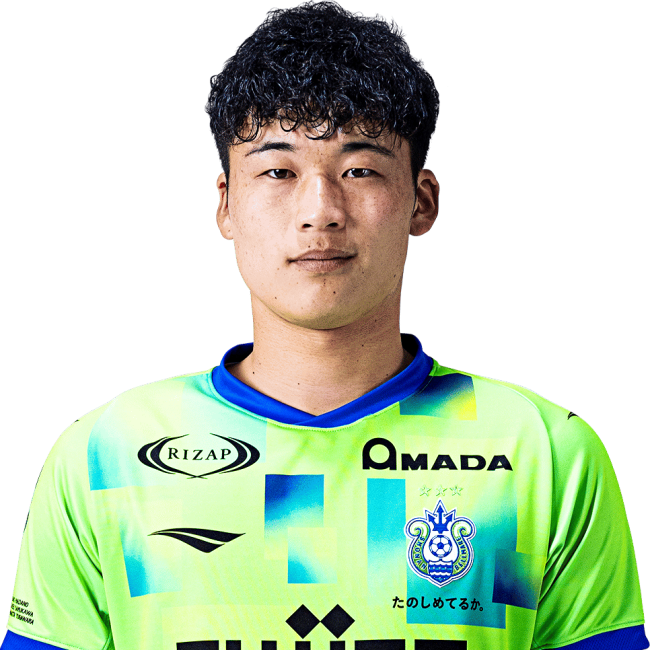
- Date of Birth: 30/07/2003
- Age: 22
- Nationality: 🇯🇵 Japan
- Preferred Position: ST
- Alternative Positions: –
- Club: Sanfrecce Hiroshima
- Height: 178 cm
- Contract Until: Unkown
Yeessss… another report, another striker after reviewing Jeremy Arévalo just a few days ago, and now, another player from an exotic/unknown league: Akito Suzuki.
Akito Suzuki is a Japanese striker who, after a successful spell at Shonan Bellmare, has just signed for his new club Sanfrecce Hiroshima, and has already proven his worth in his first two matches.
Will he earn his move to a top league in Europe? Or is he projected to be a legend in a Japanese team? Let’s unveil this player and see.
The annoying number 9
Before going any further, it is important to be transparent. We are not going to pretend that we have watched every single J1 League match, because that simply is not the case. That said, Akito Suzuki is far from an unknown profile to us. We have followed him across multiple games, including a live viewing of Shonan Bellmare 5–2 Albirex Niigata, a match in which he scored two goals and immediately stood out. Since that performance, and largely because of his outstanding intensity and untypical work rate for a striker, he became a player we made a conscious effort to track more closely.
His recent move to a club competing in the AFC Champions League further reinforces that interest. The increased accessibility of matches—many of them available freely on YouTube—allows for more consistent and comfortable monitoring, which is essential when forming longer-term evaluations rather than isolated impressions.
Moving to the player himself, Akito Suzuki is a different type of striker. He is the kind of forward who, even on days when his technical execution or finishing is not at its best, still makes you hesitate before substituting him. His value is not limited to goals or touches in the box; instead, it lies in how relentlessly he affects the opposition’s defensive structure. His profile is built around two clearly defined and highly impactful strengths.
The first is his pressing ability. Akito Suzuki never stops pressing. He constantly harries center-backs, closes passing lanes, and applies pressure with real intent rather than symbolic effort. His aggression forces defenders into rushed decisions, often pushing them into long balls or low-percentage passes. He is excellent at winning duels and loose balls, and his activity level results in an unusually high number of ball recoveries in the final third, making him one of the most disruptive forwards off the ball in his league.
The second defining trait of his game is his movement in behind the defensive line. Few things unsettle defenses more than a striker who is constantly threatening the space at their backs, and Suzuki excels in this aspect. He shows excellent timing and spatial awareness, often positioning himself just outside the defenders’ focus before accelerating into space. These runs frequently place him in dangerous finishing zones, where he can either create clear chances for teammates or convert opportunities himself.
With his new team, he is up to a promising start, 3 goals in 2 games, including a brace in his Asian Champions League debut against JDT. Seems like, in a team that better controls possession and has better facilitators, he will shine and have a break out season.
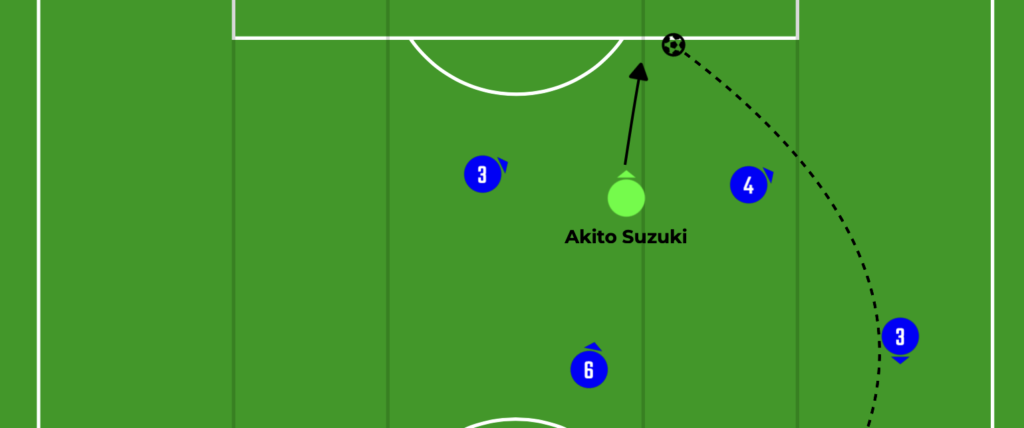
Representation of how Akito Suzuki runs behind defenders backs.
Image done using Tacticalista app.
Again… a not so proven player… And with some inconsistency
Similarly to what we observed in Jeremy Arévalo’s review, Akito Suzuki is still operating within a very limited top-level sample size. He has only produced one truly strong season, and is now entering his second year competing at the highest level. That alone should invite caution. While his profile is undoubtedly promising, it also suggests that he is a player who still requires time, stability, and the right environment to fully develop and consolidate his game.
This context becomes even more important when factoring in the technical limitations that currently restrict his overall effectiveness, particularly in relation to his playing style. For a striker whose game relies heavily on attacking space behind defensive lines, one of the most crucial attributes is clean, efficient ball control. Receiving the ball while running at speed and setting it perfectly into stride is what allows these actions to turn into clear scoring chances. In Suzuki’s case, this is an area that remains inconsistent. Although he is capable of controlling difficult balls, he lacks that natural, effortless first touch that consistently puts him at an advantage and allows him to fully exploit his runs.
As a consequence, many of his in-behind actions evolve into 1v1 scenarios rather than immediate finishing opportunities. When a quick or well-positioned defender recovers in time, Suzuki is often forced to rely on his dribbling ability to resolve the situation. At present, this aspect of his game does not feel sufficiently refined to consistently beat defenders at this level. His dribbling is functional rather than decisive, and too often these moments result in lost momentum or neutralized attacks.
Beyond this, there is still room for improvement in other key attacking fundamentals. His passing in the final third can lack precision and timing, particularly when quick decisions are required, and while his finishing is respectable, it is not yet elite or repeatably clinical. These are not red flags, but rather indicators of a player who is still very much in a developmental phase.
That said, the upside is evident. If Akito Suzuki were able to polish his first touch in stride, improve his 1v1 efficiency, and add greater consistency to his passing and finishing, his profile would change dramatically. With his relentless pressing, intelligent movement, and physical commitment, those technical improvements could elevate him into a high-impact striker. In that scenario, he would not only dominate domestically but also become a clear recruitment target for clubs in Europe’s top five leagues.
Summary
Strengths:
- Aerial duels and heading. Specialist in crosses and corners
- Great positioning and timing for his runs in behind
- Good finishing
- Great pressing and ball recovery
Weaknesses:
- Lack of game time in professional football
- Not good enough first touch for his game style
- Average dribbling
Player Comparison and Future Expectations
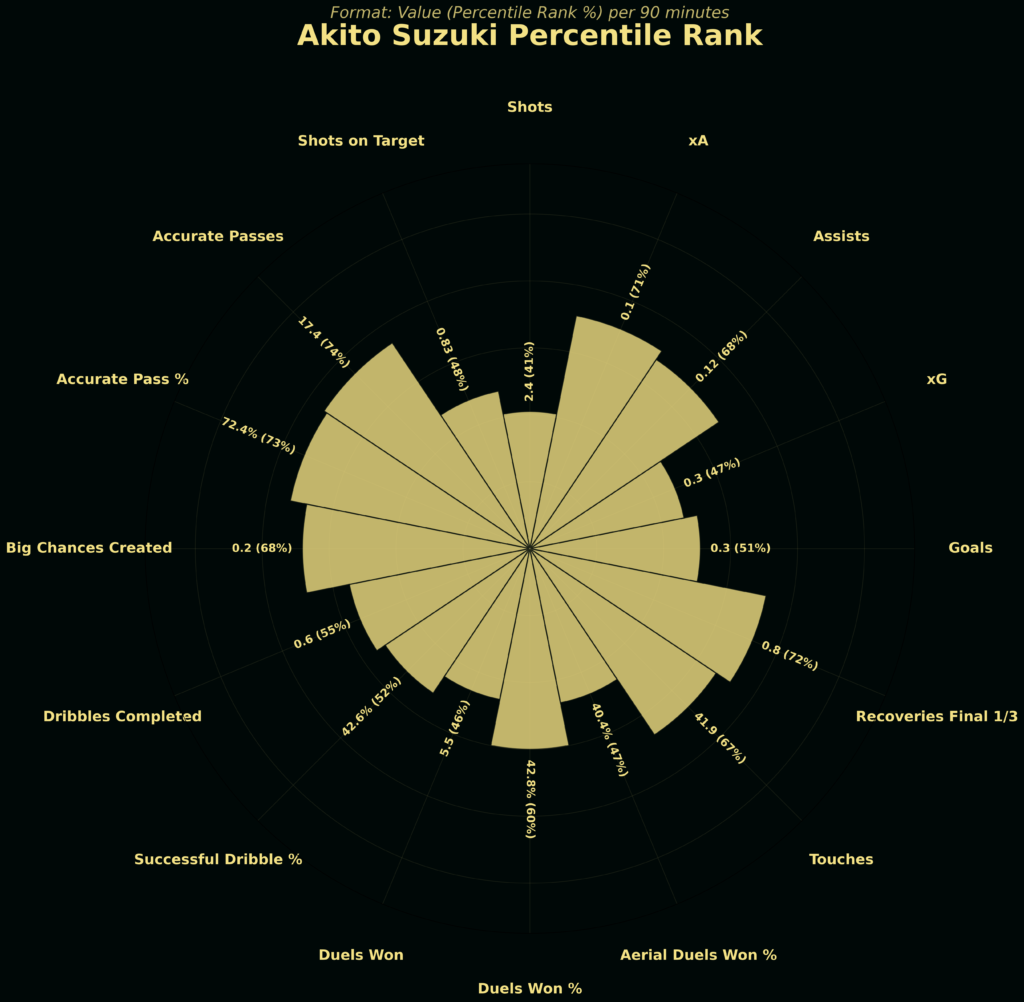
Having just completed a move to a more competitive environment, and with regular minutes now coming at Shonan Bellmare, the most sensible short-term decision for Akito Suzuki is clear: stability. Remaining at the club for at least a full season would provide him with the continuity and trust he needs at this stage of his development. Early signs are encouraging—he looks sharp, confident, and physically ready, and his strong start suggests that his market value could grow rapidly if he maintains this level. Sustained performances in this context would naturally attract attention from clubs across multiple leagues.
Looking slightly further ahead, a move to the Bundesliga stands out as a particularly logical next step. In recent years, Germany has proven to be a fertile environment for Japanese players, offering a blend of tactical structure, physical demands, and developmental patience that often facilitates smoother adaptation. The league’s emphasis on pressing, transitions, and vertical football aligns well with Suzuki’s strengths, making it a pathway that feels both realistic and strategically sound.
Alternatively, Spain would represent a more ambitious but fascinating challenge. If Suzuki manages to meet—or exceed—the expectations currently surrounding him, a club like Real Betis could emerge as an excellent stylistic fit. Betis possess high-level facilitators such as Isco, Pablo Fornals, Abde, and Antony, yet lack a consistent attacking reference point. In that context, Suzuki could offer intensity, movement, and depth, occupying central defenders, attacking space, and benefiting from a creative supporting cast capable of maximizing his off-ball qualities.
To contextualize his potential, here are some expected outcomes for him:
Best-Case Scenario
Ollie Watkins — An engine that never falls short of stamina. Great heading, nice runs in behind and an amazing commitment when pressing defenders.
Expected Outcome
Jonathan David— A fast striker that runs behind defenders backs, finds spaces and enables his team mates. He also has good definition.
Worst-Case Scenario.
Daizen Maeda — Not only is he from the same. nation, but he has very similar football traits. Fast, presses, runs in behind, scores goals…
Don’t miss out, see all our Scouted Players clicking here.