

- Date of Birth: 08/04/2006
- Age: 19
- Nationality: 🏴 England
- Preferred Position: LW
- Alternative Positions: ST
- Club: Milwall
- Height: 190 cm
- Contract Until: 30/06/2029
They say shooters shoot, and today we have our personal shot…
For now, we have shown some players that have displayed some great footballer traits consistently, either in the current season or in past season ones. Today, we have one that is included here mainly because of one game we saw live of him, and that is none other than Tom Watson.
Tom Watson is a rigth-footed LW that played in Sunderland last season and, despite not being amazing for them, earned himself a move to a bigger club like Brighton.
He is the third LW after Mika Godts and Kim Min-Su.
His time in the Premier League hasn’t been amazing and is now back in the Championship. Will he fulfill his potential? Is he fit enough to play in the Prem?
He CAN do it in a cold rainy night… against Stoke
Since this report is based mainly on Tom Watson’s last full season, where he enjoyed continuity and consistent minutes, it’s important to provide context — both about his situation then and now — to justify why he still deserves to be analyzed here.
Last season, Sunderland completed their long-awaited return to the Premier League. They looked strong throughout the campaign, competing near the top spots and ultimately securing a deserved promotion. It was a collective success more than an individual one. Sunderland functioned as a unit, and no single player clearly stood above the rest.
Even so, Tom Watson did enough to earn himself a significant move to Brighton & Hove Albion. The transfer felt like a natural next step — a young, athletic winger stepping into a Premier League environment to consolidate and elevate his level.
But football rarely follows a straight line.
This season has not unfolded as expected. At Brighton, Tom Watson has barely featured, accumulating roughly 60 minutes as a substitute in the Premier League. The anticipated “breakthrough year” turned into a year of limited opportunities.
Now, he finds himself back in the Championship on loan at Millwall. The club is fighting for promotion spots, and Tom Watson was viewed as one of the pieces capable of adding dynamism to that final push. So far, his involvement has been limited — likely a mix of tactical adaptation and competition for places.
That said, the reason Tom Watson remains relevant is simple: his profile is rare.
Tom Watson is a tall, athletic left-winger who thrives in isolation. For his height, he moves with surprising agility and speed. He is explosive over distance and particularly dangerous in open spaces, where he can stretch defensive lines and attack defenders directly.
His standout moment came in a 2–1 win against Stoke City, where he scored a brace and showcased everything that makes him intriguing — timing, aggression in 1v1s, and composure in front of goal. After watching that performance live, it was impossible not to keep following him closely.
Even during periods of inconsistency, his raw conditions remain evident.
Perhaps his most consistent trait this season has been his relentlessness. Tom Watson keeps demanding the ball. He keeps attempting take-ons. He keeps challenging defenders, even when success rates fluctuate. The confidence is there. The personality is there.
The real question is whether his execution will catch up to his ambition.
Because physically and mentally, Tom Watson has the tools. What he now needs is rhythm, minutes and refinement.
A player that needs a lot of refinement
For the first time in a while, the improvement section might be longer than the contextual and strengths analysis. And that says a lot about where Tom Watson currently stands in his development.
First and foremost, Tom Watson must improve his decision-making in the final third.
Even when he successfully beats his defender — whether through pace, power or pure 1v1 ability — the next action often lets him down. He delays the final pass when it’s clearly on. He forces it when patience is required. He shoots when he should square it. He squares it when he should attack the goal himself.
This inconsistency neutralizes much of the advantage he works so hard to create.
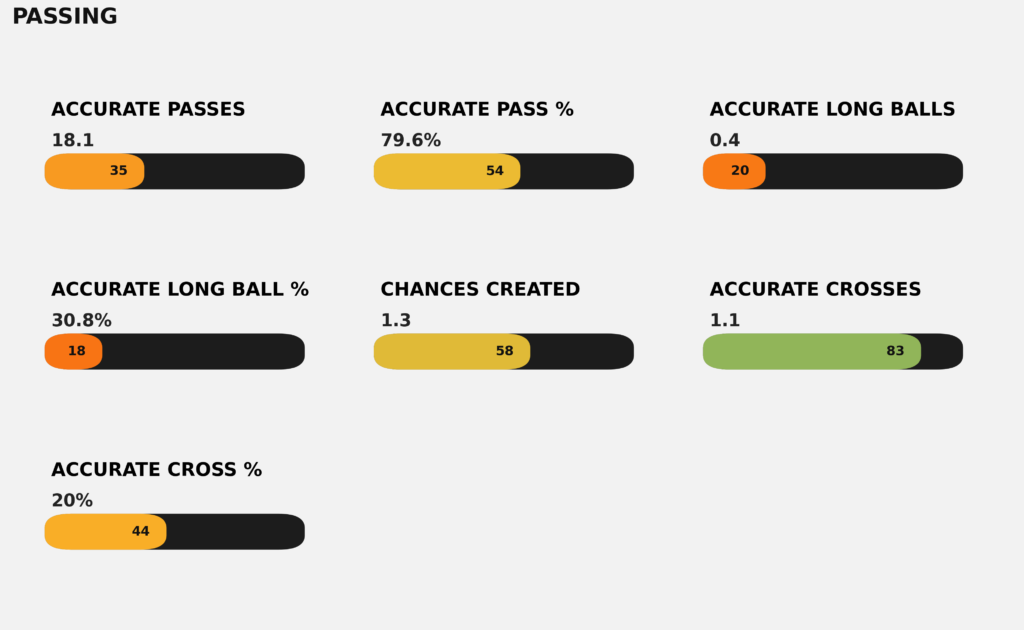
One of his recurring “safe” actions is delivering an early ball into the box and hoping something happens. While that can be effective occasionally, it feels predictable. For a player with his athletic gifts and technical base, those moments should produce higher-value decisions — cut-backs, driven low crosses, delayed passes, or even attacking the far post himself.
Another underused weapon is his physique.
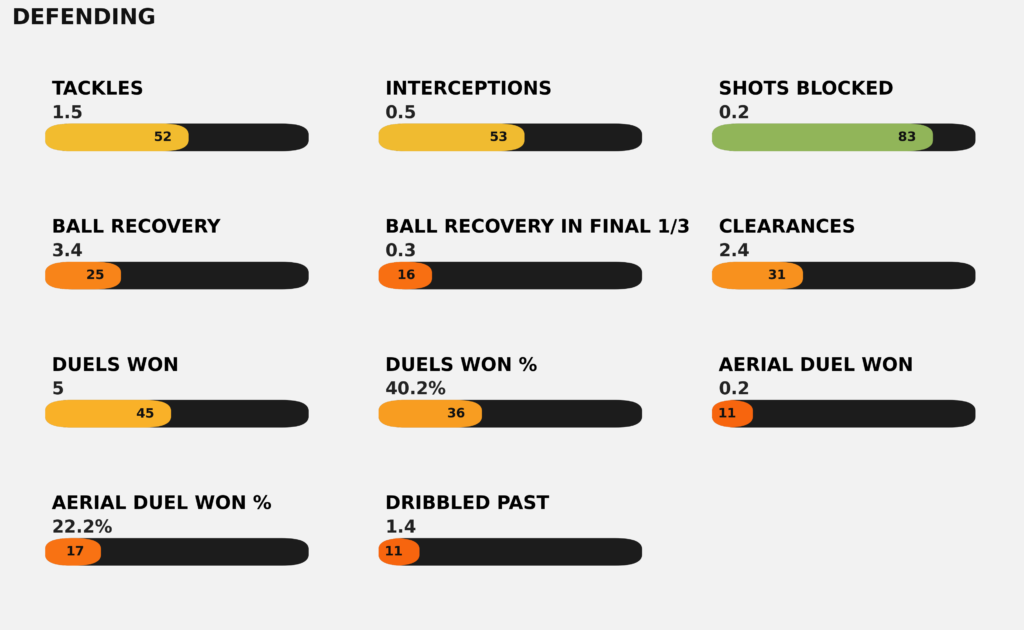
Tom Watson is tall and physically imposing for a winger. In theory, that should translate into aerial presence and dominance in shoulder-to-shoulder duels. In practice, it rarely does. He does not consistently win aerial battles nor impose himself physically against full-backs. If he learns to truly leverage his body — both in duels and when attacking the back post — his impact would increase significantly.
There is also the question of involvement.
At times, he fades from games. He could demand the ball more frequently. He could attack the space behind defenders more aggressively. He could isolate his full-back more often instead of waiting for structured build-up to reach him. A winger with his tools should be forcing defenders into uncomfortable situations repeatedly.
Finally, output matters.
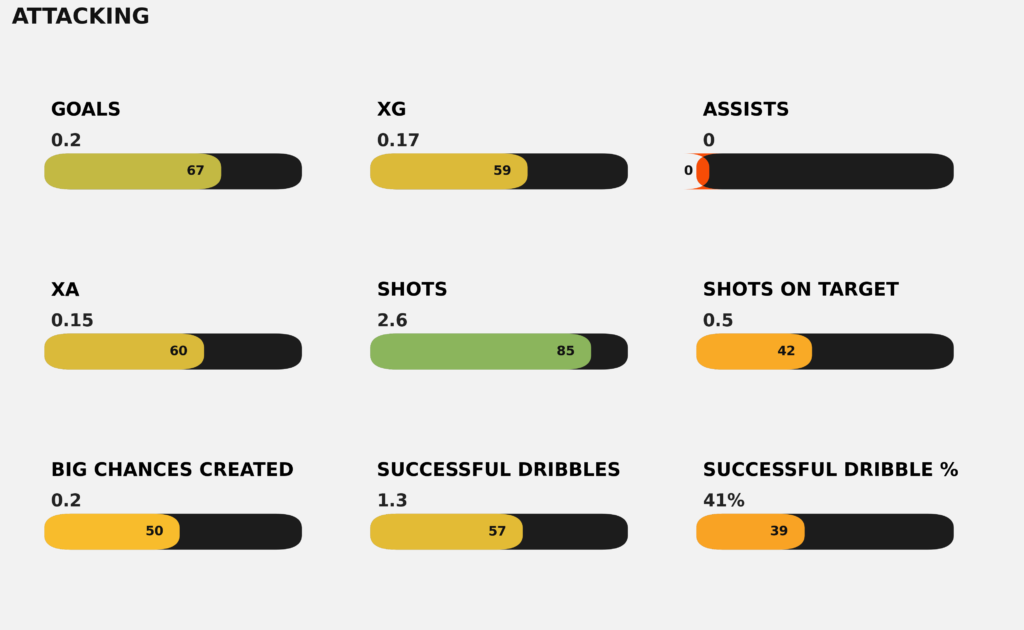
If Tom Watson were producing decisive goal and assist numbers despite these flaws, the narrative would be different. But his lack of involvement combined with inconsistent decision-making directly impacts his end product. That, in turn, shapes perception.
Summary
Strengths:
- 1v1 and take-ons
- Confidence
- Physique, fast and agile
- Vertical and direct
Weaknesses:
- Lack of G/A
- Lack of involvement
- Should use more his height and physique
- No decision making
- Puts the ball in and prays for the best
Player Comparison
In these images, the player is ranked against others in the same position and league. For each metric, you’ll see the statistic name, the player’s average per 90 minutes, and their percentile rank—which shows how they compare to their peers (e.g., an 80th percentile means they performed better than 80% of players in that group).
In today’s case, the stats are not from the current season but the prior one.
Future Moves and Player Expectations
For Tom Watson’s future steps, first he should establish himself in a team, find continuity and minutes, and start improving his flaws.
A Championship team that fights for promotion seems the best option. He knows the league, has played the opponents and wouldn’t need adaptation.
Lastly, as always, let’s use some other players to represent the hopes and aspirations we have on Tom Watson:
Best-Case Scenario
Anthony Gordon — A fearless winger who thrives in 1v1 situations and has great output. He is the key to Newcastle’s recent success, and has shown involvement and determination week in week out.
Expected Outcome
Jack Clarke — Similar profile. Shined in the Championship, and struggled after that. Back again in the Championship and being back at his best, he is a top player for the league and consistently makes great performances.
Worst-Case Scenario
Oliver Burke — Had a break out season in the Championship, earned himself a cheeky move to the Premier League and since then, has been in a lot of teams trying to find somewhere to establish despite failing. Different position, as he is more of a ST, but could see that happening to Tom.
Don’t miss out on our other player reports, look at them here.
And don’t forget to check our Instagram account, where you can find summarized player reports.